
The cooperative strengthened its commitment in 2024 by becoming part of the ‘Projet d’Appui au Développement du Cacao’ (PAD-CACAO), which aims to develop cocoa farming in Cameroon. The programme is led by the Ministry of Agriculture and Rural Development.
To identify the main areas of intervention, the PAD-CACAO project deployed a National Coordination team in Ihund (the cooperative’s head office) on 22 and 23 May 2024, in order to carry out a participatory diagnosis with the association’s members.
Through discussions and sharing of experiences, this participatory diagnosis was intended to:
Diagnosis goals and process
Through discussions and sharing of experiences, this participatory diagnosis was intended to:
- collect socio-economic data on the cooperative’s members so that actions can be adapted;
- understand the main difficulties encountered by the women producers and gather their suggestions;
- define an action plan to reach the cooperative’s goals.
To meet a maximum number of women cocoa farmers, the National Coordination team went to Ihund, as well as to the three offices of the cooperative: Iaakok, Pendjock and Ndog Njé (which has merged with Ihund).
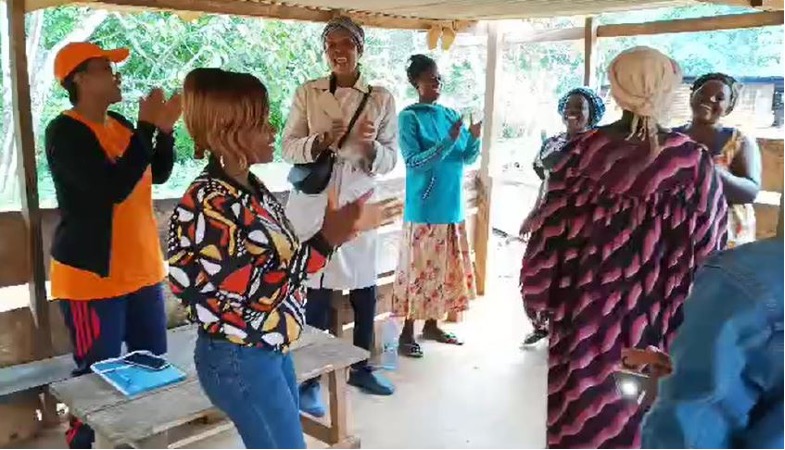
Animation of the Rural Women of the Iaakok office
The two days of discussions were organised in collaboration with the ‘Conseil Interprofessionnel du Cacao et du Café’ (CICC), which already supports the cooperative in its development.
Each participant filled in a very detailed identification sheet to collect the following information:
- identification of the woman producer;
- her production, processing and marketing data;
- her financial habits;
- any problems she has encountered and any suggestions she may have for future action.
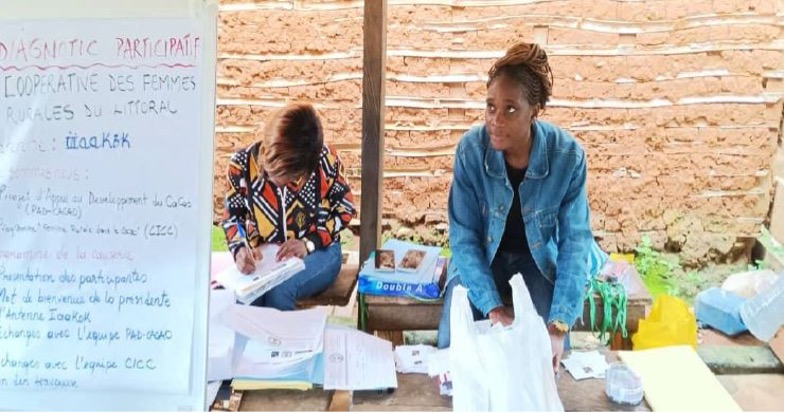
Filling in identification sheets at Iaakok
The purpose of gathering this information was to determine the income-generating activities, list the production problems, prioritise the most profitable crops and thus establish an action plan to help the cooperative to achieve its goals.
The results of the diagnosis
Because of a poor telephone network in the region, only 24 of the 50 women expected received the invitation and took part in the meetings.
Nevertheless, analysis of the data collected helped us to identify major socio-economic trends among the cooperative’s members. The following are a few key figures:
- only 17% of the members are under the age of 35 (the strenuousness of the work is thus to be taken into account in the future actions to be implemented);
- 61% of the members have a primary education level and 35% a secondary education level;
- 7 women are financially dependent on their relatives;
- 100% of the women members of the cooperative make their living from the marketing of agricultural products, and only 4% raise livestock farming (not all the cocoa fields are yet in production, which means that women make their living from other crops like cassava, macabo, yam, plantain bananas, etc.);
- 74% of the financial resources come from the producers’ own money;
- 40% of the members save their resources after sales and 35% have their own bank account;
- 91% of the members pay their financial obligations, including membership fees and annual dues;
- 70% of the workforce is family-based, and only 30% has temporary employee status.
Strengths
Each farmer has between one and four plots of food crops on average, and one hectare of cocoa trees. The diagnosis identified the crops that need to be intensified in order to pool marketing (mainly cassava and maize).
Thanks to the survey, it was also possible to identify the natural resources available in the rural area of Ihund, and the additional income opportunities they could create once developed.
The main difficulties
However, the survey also revealed major difficulties encountered by women producers.
They mentioned in particular the infertility of the soil (sometimes reinforced by the practice of slash-and-burn agriculture), the presence of insects and pests that ruin harvests, significant losses, especially on plots cultivated in polyculture, the poor quality of seeds, as well as old and inappropriate tools.
In terms of marketing, group sales activities are currently under development, but the producers deplore the poor state of the roads and the lack of means of transport, which make marketing very difficult.
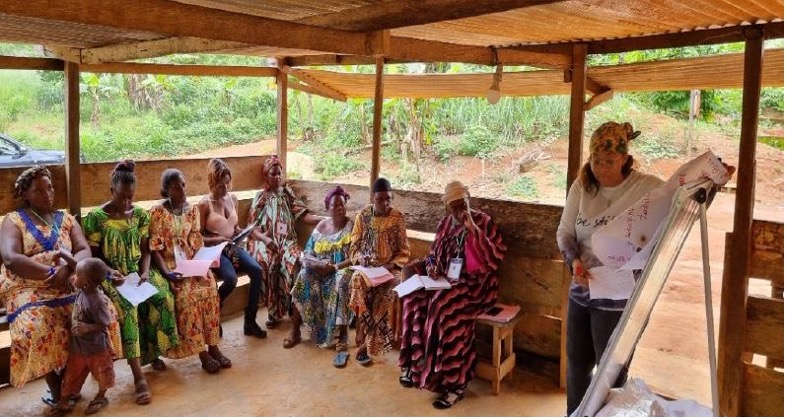
Discussions and sharing of experiences concerning production questions
Action plan and areas of intervention
An action plan has already been established with the ‘Conseil Interprofessionnel du Cacao et du Café’ to support the cooperative members for 3 years in all aspects of developing their business:
- business management, leadership, administrative and financial management, negotiation,
- equipment and infrastructure maintenance,
- cocoa farming knowledge and expertise (cocoa tree agrosystem, productivity, cocoa farm regeneration, processing techniques, preservation, packaging, and more).
- environment and quality (sustainable environmental management, awareness of cocoa traceability, health requirements, and so on).
On the basis of the diagnosis and all the data collected, the PAD-CACAO team decided to focus its support on supplying high-performance seeds and strengthening the agricultural knowledge of the Rural Women of the Littoral.
This represents a great step forward for the cooperative. We will be keeping a close eye on the results of these actions over the coming months!
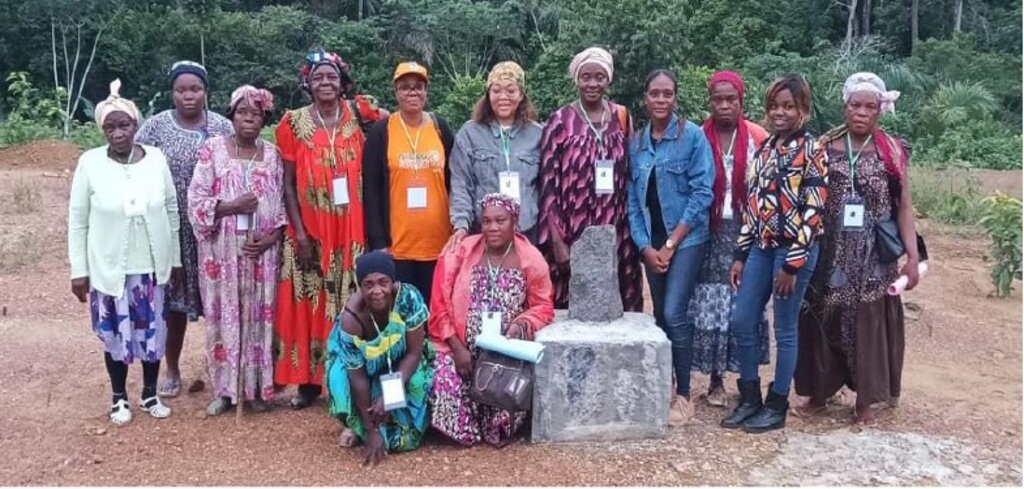
Photo of the Rural Women of the Littoral at the cooperative’s head office in Ihund.